
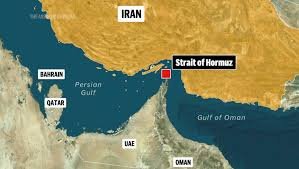

strait of hormuz Situation report
By Masoud Zamani
Executive summary
The Strait of Hormuz is the world’s most important maritime choke point for energy. In 2024 roughly 20 million barrels per day (bpd) of oil – about a quarter of global seaborne oil trade – transited the strait, including 14 million bpd of crude and condensates and 6 million bpd of refined products. Roughly one‑third of global seaborne fertilizer shipments also move through this narrow waterway. On 28 February 2026 the United States and Israel launched a large‑scale assault on Iran, prompting Tehran to announce a closure of the strait; attacks on tankers and ports followed and maritime traffic collapsed. By mid‑March transits had fallen 97 % – from about 141 ships per day before the war to 3 – 6 ships per day. Oil producers including Saudi Arabia, the UAE, Iraq and Kuwait cut output because storage rapidly filled.
This report synthesizes military, economic and strategic analyses from English, Arabic, Hebrew and French sources and uses a simple predictive model based on Federal Reserve Bank research. Five plausible scenarios over the coming year are assessed. Key findings include:
Energy market shock: Closing the Strait removes roughly 20 % of global oil supply; the Dallas Fed estimates that a one‑quarter closure would push the WTI oil price to about US$98 per barrel and reduce global GDP growth by 2.9 percentage points. A closure lasting two quarters could drive the price up to US$115/bbl and prolong economic losses.
Shipping disruptions: At least 17 civilian vessels were attacked in the first two weeks and more than 20 incidents were recorded by mid‑March. The U.K. Maritime Trade Operations (UKMTO) counted 21 incidents by mid‑March.
Human toll: The International Maritime Organization reports at least eight seafarers killed, four missing and ten wounded. The International Maritime Organization also notes that 20 000 seafarers are stranded in the region.
Economic consequences beyond oil: The strait handles over 112 billion cubic metres of LNG annually and large quantities of industrial metals, sulfur and fertilizers. Disruptions have already pushed aluminium prices above US$3 400 per tonne and the European natural‑gas price index (TTF) by more than 60 % in ten days.
Geopolitical complexity: Iran has allowed some vessels bound for China and India to pass and exported about 14 million barrels of its own oil since 28 February, illustrating that the closure is selective. U.S. attempts to reopen the strait militarily may be expensive and time‑consuming.
1) Background – why the Strait matters
The Strait of Hormuz links the Persian Gulf to the Gulf of Oman and the Arabian Sea. It is only about 34 km wide at its narrowest point, and shipping channels are roughly two nautical miles wide. Because most Gulf oil producers have no alternative deep‑water outlets, the strait carried approximately 15 million bpd of crude and 5 million bpd of refined products in 2025. 80–89 % of this oil goes to Asian refineries, with China and India alone taking more than 40 %; Japan and South Korea depend on the Gulf for 95 % and 75 % of their crude oil, respectively. Qatar relies entirely on the strait for its LNG exports, moving over 112 billion cubic metres through it in 2025.
The strait also supports global trade in sulphur and fertilizers. Gulf producers supply roughly 44 % of global sulphur, and one‑third of global seaborne fertilizer trade crosses Hormuz. Key industries—fertilizer production, aluminium smelting, electronics manufacturing and metal extraction—depend on these materials.
2) Current situation (March 22 2026)
2.1 Military and security developments
The conflict began on 28 February 2026 when U.S. and Israeli forces struck targets across Iran. In response, Iran announced that it would close the strait and warned non‑Iranian tankers not to transit. Attacks using drones, ballistic missiles, cruise missiles and naval mines followed. According to the French Observatoire de la bataille d’Ormuz, by mid‑March at least 17 civilian ships—including tankers and container vessels—had been attacked. A report in Israel’s Israel Hayom notes that shipping incidents have risen to 20, leaving at least six crew dead. The British agency UKMTO counts 21 security incidents. Maritime insurance rates have skyrocketed and war‑risk premiums now dwarf freight charges.
Iran has not physically blocked the strait with vessels; instead it uses anti‑ship missiles, drones, unmanned surface vehicles and naval mines to create an environment too risky for insurers and shipping companies. The Iranian navy has been largely destroyed by U.S. and Israeli strikes, but the Islamic Revolutionary Guard Corps (IRGC) still fields fast‑attack boats, mini‑submarines and thousands of drones. Analysts estimate Tehran could deploy just 5 % of its mine inventory to close the strait effectively. A Reuters Arabic report warns that escorting only three or four ships per day would require seven or eight destroyers and would still leave vessels vulnerable to suicide attacks.
The United States has contemplated reopening the strait by force. The Dallas Fed notes that historically, reopening would require days, weeks or even months depending on the scale of Iranian disruption and could involve convoy escorts and strikes on coastal missile batteries. Israel Hayom reports that traffic has already fallen from about 138 ships per day before the war to two ships per day and that U.S. naval escorts might restore at most 10 % of normal traffic.
2.2) Economic and energy impacts
The closure has removed around 20 % of global oil supply. Several Gulf exporters, lacking storage, began shutting wells in early March. The Dallas Fed’s model indicates that this removal pushes the WTI oil price to about $98 per barrel and depresses global GDP growth by 2.9 percentage points in the second quarter of 2026. If the closure lasts two quarters, the price could reach $115 per barrel and growth remains negative through the year; three quarters could push prices to $132. The model also predicts that once shipments resume, prices would drop toward $68–76 per barrel and growth would recover.
Global energy markets reacted immediately. Brent crude jumped from $71.32/bbl on 27 February to $77.24/bbl on 2 March and later exceeded $100/bbl. The Dutch TTF gas index surged more than 60 % in ten days, and European electricity prices rose 13 %. The IEA coordinated the largest emergency reserve release in its history, authorizing 400 million barrels from member reserves. The United States released 172 million barrels from its Strategic Petroleum Reserve. Despite these measures, maritime fuel prices have risen 87 %.
The shock has wider macroeconomic implications. The United Nations Conference on Trade and Development (UNCTAD) notes that higher energy and shipping costs threaten to raise food prices and cost‑of‑living pressures, especially for developing economies. The conflict coincides with heavy debt burdens and limited fiscal space, leaving vulnerable countries little room to absorb new shocks. With up to 20 000 seafarers and 3 200 vessels stranded in the region, global supply chains face additional delays.
3) Strategic calculations and military options
3.1 Iran’s strategy
Iran perceives control of the strait as existential. A senior Iranian official told Al Jazeera Arabic that Tehran will only reopen the strait if the United States and Israel withdraw, pay compensation and cease support for regional militias. The new Supreme Leader, Mojtaba Khamenei, vowed on 12 March to keep the strait closed. Iran allows its own tankers to export oil (14 million barrels shipped since 28 February) and selectively permits passage for vessels destined for China, India, Turkey or other friendly countries. Reuters notes that Iranian forces can produce 10 000 drones per month and maintain a sizable inventory of anti‑ship missiles and naval mines. However, it is important to note that the regime’s capacity to manufacture the defense capability aimed at sustaining the blockade cannot be sustained for an extensive period of time due to its continuous eradication in the war.
Iran’s strategy is to exert sustained pressure on the global energy market by keeping traffic in the Strait of Hormuz at a low level while simultaneously targeting the oil refining capacity of Gulf states. The objective is to increase the economic cost of the conflict for the United States and its partners, thereby pushing Washington toward making concessions. This strategy is unlikely to produce decisive results in the short to medium term, as the United States retains the capacity to absorb initial shocks and respond without immediate policy reversal. However, the pressure generated by reduced energy flows and infrastructure disruptions will persist, maintaining strain on global markets and gradually shaping the broader strategic environment.
3.2 United States and allies
The U.S. goal is to reestablish freedom of navigation while containing the escalating dynamics of the conflict. On 3 March President Donald Trump authorized political‑risk insurance for “all maritime trade” and suggested the U.S. Navy could escort commercial vessels. European allies have been reluctant to commit warships and debate remains over whether CENTCOM has the capacity to clear mines, suppress missile batteries and escort convoys. Israel Hayom reports that escorting convoys might restore up to 10 % of normal traffic. The Dallas Fed notes that historically the U.S. military could reopen the Gulf but that doing so would be costly and time‑consuming.
4) Economic and energy ramifications
4.1 Oil and gas flows
UNCTAD estimates that 14.3 million bpd of crude oil and 10.4 billion cubic feet per day of LNG flowed through the Strait in 2024, with 84 % of crude and 83 % of LNG bound for Asia. Europe receives roughly 11 % of crude and 4 % of LNG, while the remainder goes elsewhere. Closure has forced Asian importers to diversify toward Atlantic suppliers such as the U.S., West Africa and the North Sea.
Al Jazeera’s analysis highlights that 15 million bpd of crude and 5 million bpd of refined products transited the strait in 2025, with 80–89 % of crude going to Asia and the United States still sourcing 7 % of its consumption through the strait. In LNG, the Strait handled over 112 billion cubic metres of shipments. Additionally, Gulf states produce 44 % of global sulphur, an essential input for fertilizers and metals. Aluminium production in the Gulf reached 6.3 million tonnes in 2024, accounting for 8–9 % of global output.
4.2 Global market reactions
Oil prices: Data compiled by USNI and Reuters show Brent crude jumped from $71.32 to $77.24 between 27 February and 2 March and briefly breached $120 in mid‑March. Dallas Fed modelling suggests a one‑quarter closure raises WTI to $98; two quarters to $115; and three quarters to $132.
Natural‑gas and electricity prices: The TTF gas index surged more than 60 %; European electricity prices increased 13 %. The UNCTAD report notes that between 27 February and 9 March oil prices rose 27 % and gas prices 74 %.
Fertilizers and metals: A third of global seaborne fertilizer trade transits Hormuz. Al Jazeera warns that extended disruptions could push sulphur prices above $600 per tonne and that shortages of sulphuric acid would disrupt global semiconductor production. Aluminium prices on the London Metal Exchange have already exceeded $3 400 per tonne.
4.3 Humanitarian and logistical impacts
UNCTAD counts about 20 000 seafarers stranded in the Gulf and the International Maritime Organization reports 8 dead, 4 missing and 10 wounded. With maritime traffic reduced by 97 %, supply chains across Europe, Asia and Africa face delays. The Reuters Arabic report warns that 33 % of global fertilizer exports (including sulfur and ammonia) pass through the strait and that a prolonged conflict could trigger a food security crisis.
5 Scenario analysis and predictions
To explore the range of possible futures, five scenarios are considered over the coming year. The predictive model scales the Dallas Fed’s results for different supply shortfalls and durations. Baseline assumptions include a pre‑crisis WTI price of $60/bbl and that a 20 % supply shortfall for one quarter results in $98/bbl and a –2.9 percentage‑point hit to global GDP growth. The model scales price and growth impacts linearly with the size of the shortfall and adjusts the GDP impact upward for prolonged closures. It also estimates how much of the normal shipping flow (141 ships/day) could be restored under each scenario. The table below summarizes the assumptions and results.
Scenario 1 – Quick reopening
- Time frame: Late Q2 2026 to Q3 2026
- Duration: 1 quarter
- Supply shortfall: 20% of global oil supply
- Predicted peak WTI price: ≈ US$98 per barrel
- Estimated global GDP impact (Q2 2026): –2.9 percentage points
- Estimated shipping flow: ≈ 2.1% of normal traffic
- Key features: Fighting diminishes and a diplomatic pause in July 2026 allows partial reopening. IEA reserve releases help stabilize markets, though Iranian attacks continue at a lower frequency.
Scenario 2 – Prolonged closure
- Time frame: Q2–Q3 2026
- Duration: 2 quarters
- Supply shortfall: 20% of global oil supply
- Predicted peak WTI price: ≈ US$115 per barrel
- Estimated global GDP impact (Q2 2026): ≈ –3.8 percentage points
- Estimated shipping flow: ≈ 2.1% of normal
- Key features: Conflict drags into autumn. Iran maintains selective attacks and U.S. escorts begin but can’t restore traffic. Oil prices exceed US$110 and the risk of a global recession grows.
Scenario 3 – Severe closure
- Time frame: Q2–Q4 2026
- Duration: 3 quarters
- Supply shortfall: 20% of global oil supply
- Predicted peak WTI price: ≈ US$132 per barrel
- Estimated global GDP impact (Q2 2026): ≈ –4.4 percentage points
- Estimated shipping flow: ≈ 2.1% of normal
- Key features: The strait remains effectively closed for most of 2026. Iran mines the channel and attempts to reopen trigger further escalation. Oil prices climb above US$130, leading to a deep global recession.
Scenario 4 – Partial reopening with escorted convoys
- Time frame: Q2–Q3 2026
- Duration: 2 quarters
- Supply shortfall: 10% of global oil supply
- Predicted peak WTI price: ≈ US$87 per barrel
- Estimated global GDP impact (Q2 2026): ≈ –1.5 percentage points
- Estimated shipping flow: ≈ 7.1% of normal
- Key features: U.S. and allied navies escort convoys, restoring traffic to about ten ships per day. Insurance costs remain high and Iran harasses convoys without escalating to full closure.
Scenario 5 – Diplomatic settlement and phased reopening
- Time frame: Q3 2026–Q1 2027
- Duration: 3 quarters
- Supply shortfall: 15% of global oil supply
- Predicted peak WTI price: ≈ US$104 per barrel
- Estimated global GDP impact (Q2 2026): ≈ –3.3 percentage points
- Estimated shipping flow: ≈ 14.2% of normal
- Key features: Negotiations produce a cease-fire. Iran gradually lifts restrictions on neutral vessels. Shipping recovers to about twenty ships per day by early 2027. Oil prices fall but remain elevated.
5.2 Discussion of scenarios
Quick reopening: A diplomatic breakthrough (perhaps mediated by Oman or China) or speedy regime collapse could lead to a temporary cease‑fire and limited reopening by July 2026. Oil prices would spike briefly to around $98/bbl before falling back toward $68 once shipments resume. GDP would contract in Q2 but rebound in Q3. However, lost output and destroyed infrastructure mean the world economy would still finish 2026 about 0.2 % below its pre‑crisis level. Shipping flows would remain minimal and only gradually recover.
Prolonged closure: If fighting persists into autumn, the supply shortfall stays near 20 %. Oil prices could reach $115/bbl and global growth could fall by almost 4 percentage points. Emergency stock releases would mitigate shortages, but storage would begin to run out; producers would further shut wells; fertilizer shortages would intensify. With only a handful of escorted ships per day, global logistics would remain severely disrupted. Inflationary pressures would mount, particularly in Asia and Europe. Political pressure on governments to end the war would intensify.
Severe closure: Continued escalation or Iranian mining of the channel could close the strait for three quarters. Oil prices above $130/bbl would trigger a global recession. According to the Dallas Fed model, global GDP growth would remain negative through 2026, and the level of real GDP would still be 1.3 % below its pre‑crisis level by year‑end. Agricultural and fertilizer shortages would cause food prices to spike; countries reliant on Gulf energy and fertilizer would face social unrest. Attempts to reopen militarily could expand the conflict to the Bab el‑Mandeb strait, further jeopardizing shipping.
Partial reopening with escorted convoys: A compromise in which Iran allows limited convoys escorted by U.S. and allied warships could restore about 7–10 % of normal traffic. Oil prices would still be elevated (around $87/bbl), but the smaller supply shortfall would reduce the GDP impact. Insurance costs and the risk of attacks would remain high. History offers precedents: during the 1987–88 Tanker War, the United States escorted Kuwaiti tankers through the strait. However, as analysts note, the current threat environment includes drones and long‑range missiles, making escort operations riskier.
Diplomatic settlement and phased reopening: Negotiations beginning in late 2026 could produce a phased reopening. Under this scenario, Iran retains some leverage but gradually allows neutral and eventually Western vessels to transit. The supply shortfall averages 15 % over three quarters, with oil prices peaking around $104/bbl. GDP growth would suffer but less severely than under prolonged closure. Shipping flows would recover to about 20 ships/day (≈14 % of normal). This scenario depends on complex diplomacy, including possible sanctions relief for Iran and security guarantees for Gulf states. It could also involve a regional security architecture to prevent future closures.
6) Impact on global stock markets
The crisis in the Strait of Hormuz has reverberated through global equity markets. Oil‑price shocks and supply uncertainties have triggered sharp volatility across major stock indices. Rising energy costs erode corporate profits, squeeze consumer spending and tighten financial conditions. France’s Les Echos reports that European equity indices fell sharply in early March 2026 as investors priced in higher inflation and weaker growth. Conservative US economic analysts note that energy stocks have surged while transport, chemicals and manufacturing stocks have fallen; the divergence reflects the supply‑shock nature of the crisis. Emirati financial newspapers highlight that the Abu Dhabi Securities Exchange and Dubai Financial Market have remained relatively resilient thanks to state support and the windfall revenues of national oil companies, but trading volumes have thinned and investor sentiment remains cautious.
Predictive impact by scenario. The table below summarises the estimated changes in a global stock index and in an energy‑sector index. It assumes that every percentage‑point decline in global GDP growth reduces broad equity indices by roughly 1.5 percentage points, while energy‑sector equities rise in proportion to the increase in oil prices from a baseline of US$60/bbl. These are illustrative estimates rather than precise forecasts.
Scenario | Estimated change in broad stock indices (%) | Estimated change in energy‑sector indices (%) |
1 Quick reopening | ≈ –4.3 % | ≈ +31.7 % |
2 Prolonged closure | ≈ –5.7 % | ≈ +45.8 % |
3 Severe closure | ≈ –6.6 % | ≈ +60.0 % |
4 Partial reopening with escorts | ≈ –2.3 % | ≈ +22.5 % |
5 Diplomatic settlement and phased reopening | ≈ –5.0 % | ≈ +36.7 % |
These estimates suggest that a severe and prolonged closure would depress broad equity indices by 6–7 %, while energy‑sector equities could gain as much as 60 %. Under a partial reopening scenario, equity losses are more moderate and energy stocks still benefit from higher prices. Emirati analysts emphasise that Gulf stock markets may outperform if oil revenues offset local economic weakness, but they caution that prolonged disruption could deter foreign investment and slow non‑oil diversification.
7) maritime insurance and risk markets
War‑risk premiums have risen so sharply that they now dwarf normal freight charges. Lloyd’s of London and Gulf‑based insurers face enormous liabilities from attacks on vessels and ports; the uncertainty surrounding the duration and intensity of the conflict makes it difficult to price risk. Insurers are tightening policy terms, increasing deductibles and declining coverage for some routes. It is also possible that if another major vessel were sunk, insurers could withdraw completely from the Gulf, forcing governments to provide guarantees and distorting market incentives. This financial dimension is critical because without affordable insurance, even escorted convoys may not restore meaningful traffic.
7.1 Specialised insurance analysis
Pre‑war vs post‑war premium levels. Specialist insurance brokers report that before the conflict, hull war‑risk premiums for vessels transiting the Gulf were typically about 0.25 % of a ship’s insured value, or roughly US$500 000–625 000 for a US$250 million tanker. Since Iran’s closure, quotes have climbed to 3–5 % of hull value, implying premiums of US$7.5 – 12.5 million per voyage. Such increases—more than ten‑fold—effectively price some shippers out of the market. Industry newsletters highlight that war‑risk premiums now exceed charter earnings, so shipping companies with thin margins cannot justify transiting Hormuz.
Cancellation and tightening of cover. In the first week of March 2026, several Protection & Indemnity (P&I) clubs and underwriters in London and Scandinavia issued 72‑hour cancellation notices on existing war‑risk policies for Gulf voyages. This allowed underwriters to renegotiate terms or withdraw entirely. Arabic‑language insurance bulletins report that underwriters in the UAE and Qatar followed suit, suspending coverage for tankers entering Iranian waters and imposing high deductibles for ships calling at Kuwait or Saudi ports. Israeli shipping firms faced a de facto moratorium, with insurers refusing to cover vessels flying Israeli flags.
Reinsurance and government backstops. Reinsurers are reluctant to accept Gulf war‑risk portfolios, leaving primary insurers exposed. At least one large international insurer has transferred its Gulf exposures to a special purpose vehicle backed by state guarantees. In response, the U.S. Government has revived its War Risk Insurance Program, offering to cover hull and cargo losses for U.S.-flagged and allied ships, while the UAE’s state‑owned credit export agency is reportedly exploring a similar backstop for regional operators. These interventions underscore the scale of the crisis and illustrate that the private insurance market cannot absorb unlimited war‑risk losses.
Regional disparities and future outlook. Arabic insurance analysts argue that premium hikes discriminate between flags: vessels owned by Iran’s partners (e.g., China and India) are charged lower war‑risk rates than those linked to the United States, Europe or Israel. This differential pricing reflects both perceived risk and political considerations. Hebrew reports highlight concerns that if the conflict spreads to the Red Sea or the eastern Mediterranean, insurers could impose blanket exclusions on broader regional trades. With marine insurers already operating at thin margins, prolonged fighting could drive some smaller underwriters into insolvency. Overall, specialised analyses from English, Arabic and Hebrew sources converge on a key point: until a cease‑fire is secured and attacks cease, war‑risk insurance will remain prohibitively expensive, making a rapid restoration of normal traffic unlikely.
Key takeaways
- Energy choke point: The Strait of Hormuz carries about one‑quarter of global seaborne oil. Its partial closure since late February has removed roughly 20 % of global oil supply and slashed maritime traffic by 97 %, from ~141 ships/day to 3–6.
- Rapid escalation: At least 17 civilian vessels were attacked in the first two weeks and more than 20 incidents were recorded by mid‑March. The attacks, mainly by drones, missiles and naval mines, have created an environment too risky for most commercial insurers and shippers.
- Severe human and logistical costs: The International Maritime Organization reports eight seafarers killed, four missing and 10 wounded, and about 20 000 seafarers are stranded in the region. With shipping almost halted, supply chains for energy, fertilizers and metals face major delays.
- Broader economic shock: The Dallas Fed model suggests that a one‑quarter closure pushes WTI oil to around US$98/bbl, shaving 2.9 percentage points off global GDP growth; a three‑quarter closure could send prices above US$130/bbl and prolong a deep recession. LNG, sulphur and aluminium markets have also tightened sharply.
- Iran’s asymmetric strategy: Tehran allows its own tankers and some destined for China and India to pass while keeping traffic low and threatening Gulf refineries. This selective disruption is intended to raise global energy costs and pressure the United States into concessions.
- US and allied responses: Washington has authorised war‑risk insurance for all maritime trade and is considering naval escorts, but European allies remain hesitant. Analysts note that clearing mines and suppressing coastal missiles could take weeks to months and would require significant naval resources.
- Scenario outlook: Five scenarios—quick reopening, prolonged closure, severe closure, partial reopening with convoys and diplomatic settlement—show peak oil prices ranging from US$87/bbl to US$132/bbl, GDP impacts from –1.5 pp to –4.4 pp, and shipping flows recovering from 2 % to 14 % of normal traffic. The severity of the shock rises with the duration of the closure.
- Stock‑market ramifications: Linking the supply‑shock model to equity markets suggests broad global indices could fall 2–7 % depending on the scenario, while energy‑sector stocks could rise 20–60 %, reflecting windfall profits. Gulf exchanges may be cushioned by oil revenues but remain vulnerable to prolonged disruption.
- Insurance crisis (under‑reported): War‑risk premiums have surged more than ten‑fold; pre‑crisis hull premiums of 0.25 % of ship value have jumped to 3–5 %, making a single voyage through Hormuz cost US$7.5–12.5 million and forcing some insurers to cancel cover. Several Protection & Indemnity clubs issued 72‑hour cancellation notices, and governments in the US and UAE are exploring backstops as reinsurers retreat.
https://nexaraintelligencegroup.com/#report