
Where Is homeland-part III
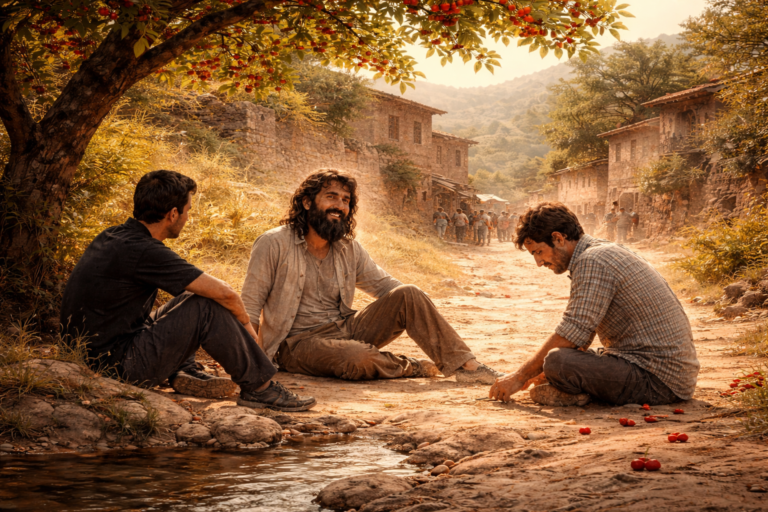
As I walk down the sharp slopes of the village with Hojat, a quiet anticipation gathers in me. The alleys are unusually crowded for a summer weekday. Perhaps the village offers a brief refuge from the heat—its own cool breath. That is what I find myself thinking. I look ahead and see a man approaching us.
He is thin and lean, in his mid-thirties like myself, his smile half-hidden behind a long beard. There is something about his face that recalls the nearly extinct dervishes of Iran—though he carries himself with more athletic ease. As we greet each other, he says casually, You look exhausted, Dr. Masoud.
For a brief moment, I am caught off guard. How does he know my name? And how does he know that I am a doctor?
He notices my surprise and smiles. Don’t worry, he says. I’m not a mystic. Hojat has already messaged him, he explains—telling him that he has met someone very much like himself. I glance at Hojat, who suddenly looks a little uneasy.
Let’s sit somewhere, Hojat suggests.
I gesture toward the café just around the corner, but the man shakes his head. No, he says. We don’t really need chairs to sit, do we? A narrow waterway runs just ahead of us. He settles onto the sand and motions toward the ground. Here, he says, let’s make ourselves at home.
I am wearing my usual black trousers—not exactly suited for the terrain. I think I can kneel, at least. But he reclines easily on the sand and murmurs, almost to himself, I really love the Fars sun. It is sharp and gentle at once.
He notices my hesitation. Don’t worry, Doctor. Dust is not dirt. Sit. Be comfortable.
For him, dust clearly is not dirt. His khaki trousers are already coated with it, and I have seen cleaner hair than his curly, wind-tangled beard.
What brings you to Fars? I ask.
Bringing brings me here, he replies. Do you really need a reason to go somewhere?
As I sit there, I notice Hojat playing with the dust, shaping it absentmindedly—like a child absorbed in molding dough.
He introduces himself as Siavosh. His given name is Hossein, but I may call him Siavosh. His face reminds me of the late Persian poet, Sohrab Sepehri. As that thought lingers, he begins to speak about himself.
He once worked as a successful civil engineer. He is originally from Zanjan—Azeri by background. His Persian is eloquent, measured, yet touched by a faint Azeri accent that gives his words a particular texture. I listen without interrupting.
He points toward a thick, old cherry tree nearby. Have you ever paid attention to the geometry of a tree?
I tell him that I observe trees—but not geometrically.
His eyebrows relax. He turns toward me and begins.
A year ago, he says, when I completed the largest project of my career, I was full of joy. I handed it over, said goodbye to the owner, and waited for the final payment.
Standing there, looking at the building in its white, polished landscape, something shifted. I began to see every block, every window, every yard with its bars. Every floor. Every unit.
Everything was square.
The door. My car. My phone. Everywhere I looked—squares. Or more precisely, everything we have built is square.
He pauses and looks at me.
Doesn’t that tell you something, Dr. Masoud?
Does it? I ask.
He smiles. Of course it does—at least it did for me. We have trapped ourselves inside a square-shaped algorithm. A prison of patterns. Every cell squared.
He sighs, turns back to the tree, and his voice softens.
Look at that tree. Do you see anything square? It has a different geometry. That’s what I meant.
He falls silent. I do too. The branches stretch outward like hands reaching for eternity. I notice the ripe red cherries, those still green, and the fallen fruit below—the bruised ones, the rotten ones, darkening in the dust.
Then he breaks the silence.
You look exhausted, Dr. Masoud.
I am not sure what he means—exhausted from the road, or exhausted more deeply. Not really, I say. Perhaps too many square miles from Shiraz.
Hojat has drawn a cherry tree in the sand. Look, he says.
Siavosh laughs. A cherry tree with an orange-tree complex.
It isn’t particularly funny, but the way he says it makes us laugh. Hojat says it’s still better than the one they painted on the wall of his shop alley in Shiraz.
They tell me that days earlier, with no experience and no plan, they decided to make graffiti—a farm, a sun, a few clouds. From dawn to dusk, they worked on it. It was cute, Hojat says. My brother didn’t like it.
We argued, Siavosh adds. And I left.
Strangely, they both seem pleased.
You’re lucky your brother hasn’t sued you, I tell Hojat. That could be vandalism.
He might, Hojat says, smiling. If that happens, I’ll come to you for legal advice, Dr. Masoud.