
wHERE IS HOMELAND - PART II
It was May 2022—eight years after my return. Looking back, I could see little but ruins: a country in decline, a people sinking into misery. Iran had once been great, yet it had not been treated well.
Something had changed in me, though. Upon my return, I began to notice a strange phenomenon growing within. With each passing day, my love for the country deepened, even as my disdain for its conditions intensified. It was an emotional dilemma unlike any other: love for a place paired with sorrow for what it had become. Homeland, at least in my heart, had come to mean something real. Roots are real. And while the revolutionary mind is often moved by the fantasy of rootlessness—by the desire to sever roots and rebel against them—roots do matter.
Over the past eight years, I embarked on many missions of exploration across the country. I wandered through the ruins of Sasanian cities, encountered a nature of astonishing diversity, and met a people who deserved far more than what history had handed them. This was why, a year earlier, I set out on a hitchhiking journey. I wanted to understand the roots—to face them directly, to live among the people.
There was another reason, quieter but heavier. I knew that soon I would have to bid farewell. And before doing so, I needed to kiss the country goodbye.
It was a journey charged with both excitement and sorrow. This was during the height of COVID, when teaching had moved entirely online. The circumstances gave me an unexpected freedom: to teach remotely while moving through the land. And what better way to deliver a lecture than not from the confines of a room, but standing before the Caspian Sea.
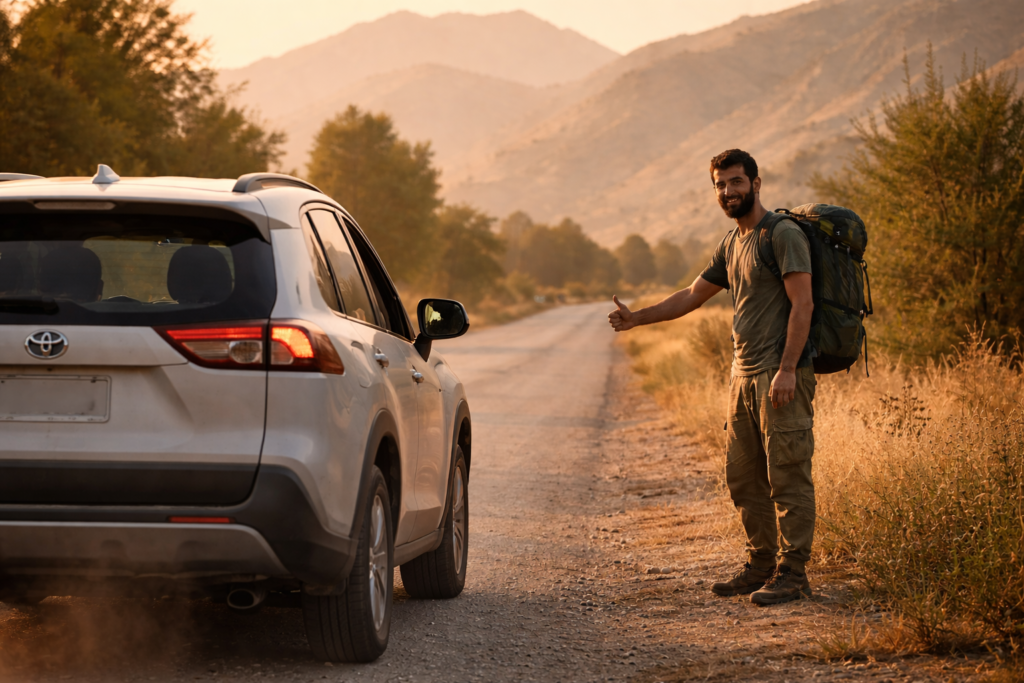
The decision itself was somehow sudden and organic. I was driving from Shiraz toward a nearby village—a place that had become my refuge, a quiet space where I could breathe. On the road, under the burning Shiraz sun, I noticed a young man standing by the roadside: stained green trousers, a sweat-soaked shirt, and the unmistakable backpack of a hitchhiker. I decided to give him a ride.
I had always liked hitchhikers. Whenever the opportunity arose during my commutes, I picked them up. There was something about their carefreeness that appealed to me. With them, conversations came easily—often deeper than those I had with people I knew well. Over time, I had come to realize that for many, hitchhiking was not merely a way of traveling, but a lifestyle, often charged with philosophical meaning. Hitchhiking, in its own way, is a refusal of habit—a quiet rebellion against the familiar, turned into a lived decision. I sensed that this young man might carry something of that spirit as well.
It turned out that he had only just made the decision to hitchhike, and that I had picked him up on the very first day of his journey. His name was Hojat. He held an MBA from Tehran University—a man roughly my age, bearded, his skin already beginning to show the early signs of sunburn. His voice was soft and slightly squeaky, suspended somewhere between conviction and anxiety.
Hojat was on his way to visit another hitchhiker who had recently convinced him to give this way of life a chance. It was immediately clear that he had developed a deep respect for this person. He insisted that I come along as well—I’m sure the two of you will have a lot to discuss, he said.
As it turned out, Hojat was heading to the very same village as I was.
Why not talk?
Read: Part 1, Here, and Part 3: Here