
The Gorbachev Illusion: The False Promise of Reform in the Islamic Republic
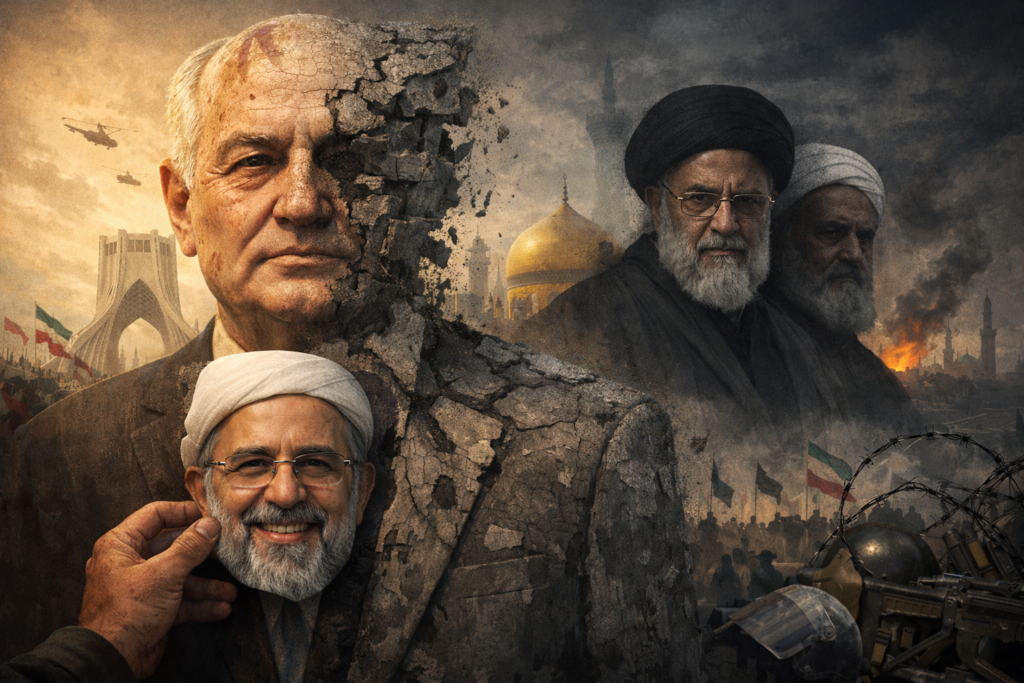
The durability of modern authoritarian systems is one of the more unsettling features of contemporary politics. Henry Kissinger once suggested that revolutionary regimes, if they prioritize survival over transcendence, will eventually collapse under the weight of their own inertia. Yet this assumption now warrants closer scrutiny. What appears, from the outside, as stagnation or reluctant reform may in fact reflect a far more calculated strategy. Authoritarian systems may learn not only to endure, but to adapt—by identifying the cognitive and normative biases of their rivals, particularly in the West, and then reverse-engineering those assumptions to their own advantage. In this light, the appearance of reform need not signal transformation at all; it may instead represent a refined technique of regime preservation.
Few regimes illustrate the paradox of authoritarian durability more starkly than the Islamic Republic of Iran. After nearly five decades of rigid ideological rule, the system appears simultaneously exhausted and intact—its escalating confrontation with Israel and deepening domestic unrest once again framed as signs of an impending collapse. Yet the very longevity of the regime complicates these predictions. If survival, rather than ideological renewal, has been the guiding imperative, then the question is not why reform has failed, but whether the promise of reform itself has become a tool of adaptation. To what extent has the Islamic Republic learned to deploy the language, symbols, and expectations of reform—not as a path toward transformation, but as a means of managing external pressure, misleading foreign observers, and extending its own lifespan?
This analysis engages with that question. It argues that one of the central reasons for the regime’s longevity lies in its ability to manufacture and sustain a false promise of reform, tailored to the sensibilities of the Western liberal imagination. The Islamic Republic has repeatedly leveraged this illusion—offering cycles of pseudo-reform, controlled openings, and curated “moderates”—to reset foreign perceptions, diffuse pressure, and re-legitimize itself without altering its ideological core. What is striking is not merely the regime’s strategic use of this discourse, but the ease with which it continues to find fertile ground in Western academic and policy circles. The result is a persistent misreading of Iran’s political trajectory, one that has repeatedly granted the system time, space, and credibility it would otherwise have lacked.
The Gorbachev Analogy: How Cognitive Bias Distorted Western Analysis
In politics, few cognitive distortions rival the availability heuristic in the scale of misjudgments it can produce. As Kahneman and Tversky put it, people “assess the frequency of a class or the probability of an event by the ease with which instances or occurrences can be brought to mind.” Jervis showed how this logic plays out in high-stakes foreign policy: leaders “learn too much from what happens to themselves” and allow vivid personal experiences to “exercise too great an influence over [their] dispositions” leading them to quick, oversimplified causal stories in which “the most salient features” of a situation are treated as the causes of its most visible outcomes. Jervis notes that this bias is particularly pronounced when the observer lacks direct experience of the new phenomenon and is therefore driven to interpret it through the prism of earlier, personally lived experiences.
This dynamic played a decisive role in shaping how the West interpreted its encounter with the Islamic Republic and, consequently, how it crafted its strategy toward Tehran. But this immediately raises a crucial question: what was the familiar experience through which the West filtered the Islamic Republic, and how did this interpretive lens mislead policymakers and analysts so profoundly?
The answer lies in the example of the Soviet collapse. The fall of the Berlin Wall marked the moment when the liberal order reached its zenith: an entrenched superpower appeared to yield to internal and external pressures, and—crucially—liberalism seemed to triumph without direct military confrontation. To outside observers, a figure like Gorbachev appeared to play the decisive role in widening the fractures within the Soviet system. From this, a powerful conclusion took hold: wherever a totalitarian regime initiates reforms, those reforms can intensify internal contradictions, accelerate liberalization, and set the stage for eventual collapse.
The “Gorbachev factor” has become so deeply embedded in the global political imagination that analysts skeptical of political change in countries like China now routinely warn the world not to wait for another Gorbachev. Their caution is a direct response to the immense body of literature in Western policy analysis that has, for decades, contemplated the possibility of a Chinese Gorbachev. In this discourse, the name Gorbachev came to function almost as a secular messianic symbol: a shorthand for the hoped-for moment when an entrenched authoritarian system might fracture from within. Thus, in the political theology of authoritarianism studies, Gorbachev became less a historical figure than a metaphor for deliverance—a singular, exceptional figure elevated into a model, despite the fact that his case was anomalous and structurally irreproducible.
Iran followed a similar trajectory. The very name “Gorbachev” became shorthand in Western policy circles for understanding Tehran’s reformist currents. Suzanne Maloney’s work on the Khatami presidency was explicitly titled Ayatollah Gorbachev, and a voluminous literature soon emerged drawing direct parallels between Khatami’s project and Gorbachev’s perestroika. The metaphor became so entrenched that it evolved into a distinct analytical template, shaping how Washington interpreted every subsequent episode of supposed moderation in the Islamic Republic. It remains, even today, one of the most persistent—and misleading—frames guiding U.S. foreign policy toward Iran.
What is striking, however, is that neither Khatami nor any reform-minded president who followed him ever delivered the structural reforms they promised. Not a single initiative—whether political opening, civil-society expansion, or judicial moderation—created even the smallest fracture in the ideological core or institutional architecture of the Islamic Republic.
Over time, this pattern produced a profound shift inside Iran. With the benefit of hindsight, many Iranians now view figures like Khatami as apologists for the system—unwitting agents of regime preservation rather than its transformation. Among the public, the entire reformist project is increasingly denounced as a “hoax” designed to prolong the life of the regime by offering symbolic concessions in place of genuine change.
Reformism as Strategy: How the Regime Weaponized Western Expectations
The regime quickly grasped the power of the analogy being drawn between Khatami and Gorbachev. Sensing the risks inherent in such a comparison, Khamenei moved swiftly to neutralize it. In a doctrine-setting speech, he warned explicitly that “Western commentators have made several mistakes. Their first mistake is assuming Khatami is Gorbachev. Their second mistake is assuming Islam is communism. And their third mistake is assuming the popular democracy of the Islamic Republic resembles the dictatorship of the proletariat.”
He went further, adding that “I would feel terrible to draw such a comparison. This noble man, devoted to the Revolution and to Imam Khomeini, cannot be likened to Gorbachev.” Ironically, history ultimately vindicated Khamenei’s warning. Neither Khatami nor any of his successors ever defected from the regime’s dominant narrative; all remained unwavering loyalists, even at moments of political isolation, public outrage, or national crisis.
Domestically, the manufactured promise of reform functioned as a dim but carefully managed light of hope—just bright enough to prevent disillusioned citizens from embracing the language of regime change, yet never strong enough to threaten the ideological foundations of the state. Internationally, the illusion of internal pluralism allowed Tehran to perform a semblance of democratic debate, presenting a curated spectrum of “moderates” and “hardliners” for foreign audiences eager to discover their next Gorbachev.
Both functions served a single purpose: preserving the regime by controlling the psychology of expectation—at home through deferred hope, and abroad through strategic misdirection.
At moments of political deadlock, reformists reliably signaled to the West that the regime was open to dialogue, effectively buying the Islamic Republic a new lifeline. The leadership quickly recognized the value of this mechanism. Thus, with Rouhani’s election, Khamenei could temporarily halt mounting international pressure through negotiations—and even a nuclear agreement—while preserving every core element of Iran’s regional security architecture.
In practice, outside the narrow domain of nuclear talks, no reformist administration was ever permitted to alter the regime’s foundational foreign-policy doctrines—from its regional proxy network to its hostility toward the United States and Israel. The continuity was absolute. Inside Iran as well, the record is unequivocal: not a single durable or structural reform took hold under any reformist government. The appearance of moderation functioned as a tactical valve, never as a pathway to transformation.
Crucially, at moments of existential crisis, reformists have never hesitated to close ranks behind the regime. During the twelve-day war with Israel, reformist figures amplified nationalist rhetoric while carefully avoiding any acknowledgment that it was the Islamic Republic—not the Iranian people—that had engineered the confrontation. Some such as Soroush, the intellectual lodestar of the reformists movement, went even further, branding those who called for regime change during the conflict as “mercenaries of Israel,” a line indistinguishable from the propaganda of the security establishment.
Now, as the regime faces its most severe legitimacy crisis in decades, the pattern has repeated itself: the reformist camp has once again rallied behind the state, affirming that when the regime’s survival is at stake, the divide between “moderates” and “hardliners” collapses into a single, unified front. Sayyid Mohammad Khatami—the would-be Gorbachev of Iran—offered perhaps the clearest illustration of reformism’s structural loyalty during the twelve-day war with Israel. In a statement after the conflict, he declared that “missiles and people” were the two pillars of Iran’s “victory” over Israel, carefully avoiding even a hint of criticism toward the regime’s decades-long regional policies that had brought the country to the brink of war. Just a year earlier, he had warned that “if the regime is lost, everything will be lost,” a remark that now reads less as analysis than as confession. For Khatami, as for the reformist establishment he represents, the fate of the republic and the fate of their political identity remain inseparable.
Why Reform Never Came: Totalitarian Logic and the Myth of Internal Moderation
Several factors help explain the reformists’ unwavering loyalty to the regime. At the discursive level, the founders of the reformist movement were themselves hardline revolutionaries in 1979 and throughout the formative years of the Islamic Republic. Many of the students who seized the U.S. Embassy—and who later sent their own children to study in the United States—are emblematic of this paradox. They still regard themselves as children of the revolution, custodians of a historic project whose legitimacy they are unwilling to renounce. For them, the 1979 revolution remains a cause worthy of defense, even as millions of Iranians have moved beyond it and now view the revolution as a historic miscalculation that cannot be redeemed.
Ideologically, reformist elites continue to identify with the anti-Israel, anti-Western underpinnings of the revolutionary narrative. This alignment is not simply rhetorical; it reflects a deeper generational attachment to the original ideological grammar of the Islamic Republic—one that no amount of electoral moderation has ever meaningfully altered.
On a more pragmatic level, the reformists have become direct beneficiaries of the Islamic Republic’s political and economic order. Over decades, they have been deeply integrated into the system’s patronage networks and have enjoyed the material advantages that flow from its endemic corruption. Many among them remain shareholders in the regime’s power structure—embedded in its bureaucratic apparatus, connected to its security establishment, and entangled in its economic conglomerates and semi-state enterprises.
To genuinely oppose the regime would require not only ideological rupture but also a renunciation of the privileges, protections, and wealth that the system has conferred upon them. It is therefore unsurprising that reformist elites consistently choose preservation over principle. Their survival—and their comfort—remains tied to the survival of the Islamic Republic itself.
Interestingly, the debate over “reform from within” and its relationship to meaningful change is as old as Gorbachev’s rise itself. Václav Havel, in The Power of the Powerless, famously warned against overinterpreting the promise of reform in totalitarian systems. He argued that so long as self-proclaimed reformers remain faithful to the rituals, symbols, and orthodoxies of the governing ideology, their reformist posture is hollow. In such environments, ideology does not merely constrain political action; it defines the boundaries of what can be imagined as change. Any reform that does not rupture the underlying ideological grammar is, in Havel’s view, simply another mechanism for the regime to reproduce itself under the illusion of transformation.
Of course, Gorbachev’s reforms and the ensuing collapse of the Soviet Union marked a decisive turning point in Western understandings of authoritarian durability. Before Gorbachev, the prevailing assumption—articulated forcefully by Zbigniew Brzezinski in the 1950s—was that totalitarian systems could not be dismantled from within. Their grip on society, Brzezinski argued, stemmed from their capacity to project a futuristic ideological vision that outcompeted the stagnation of mere authoritarianism. Only external force, in this view, could dislodge such regimes. The Gorbachev moment appeared to overturn that logic: an entrenched totalitarian state began to unravel through reforms initiated by its own leadership. What was neglected in the Western reading, however, was that this should have been understood as an exception—not elevated into a universal model. Instead, the anomaly became the framework, and the singular became the template through which the West interpreted internal reform across other authoritarian systems, including Iran.
As Andrew Nathan argues, in the contemporary technology of authoritarian power, reformist discourses have become symptoms of authoritarian resilience—not pathways to its redefinition.
In the end, Khamenei was right: Khatami was not Gorbachev, and Iran was never the Soviet Union. Yet for analysts whose thinking is shaped—often unconsciously—by the availability heuristic, this reality remains difficult to accept. The gravitational pull of familiar historical analogies continues to distort perception, making it easier to imagine an Iranian Gorbachev than to confront the structural logic of the regime itself.