
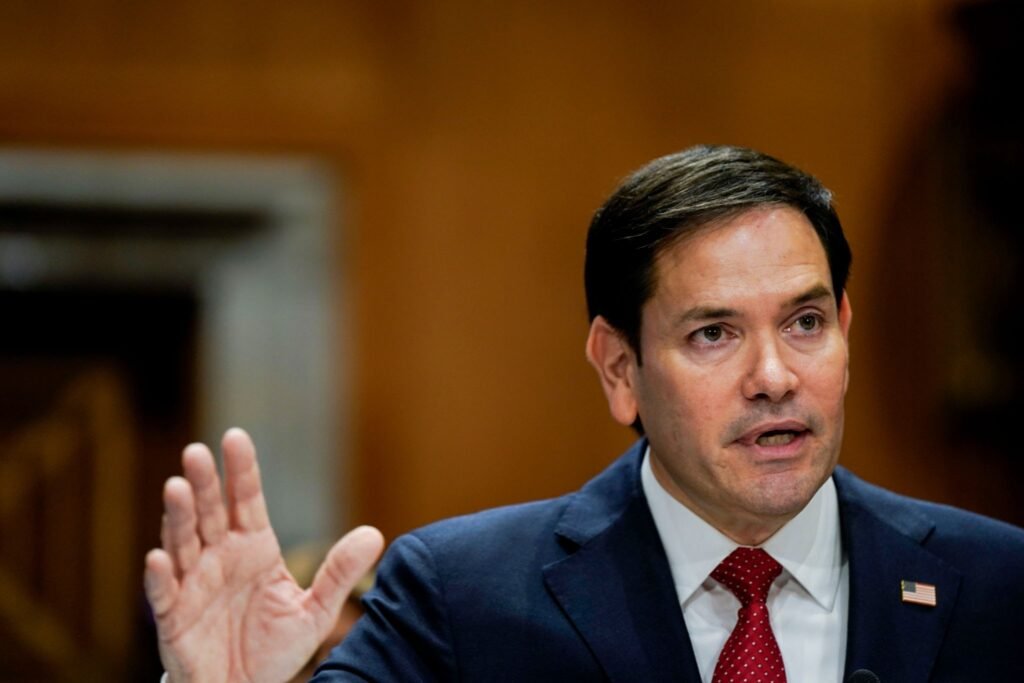
In Search of a Rubio Doctrine
It is now nearly a year since Marco Rubio assumed the dual role of Secretary of State and National Security Advisor—an institutional configuration without precedent since Henry Kissinger. The comparison is inevitable, yet the parallels are neither straightforward nor symmetrical. Kissinger was both a doctrinal statesman and a disciplined pragmatist, crafting a grand strategic architecture even as he engaged in hard-edged realpolitik. Rubio, by contrast, does not present himself as an architect of doctrine in the classical sense. His worldview is more rhetorical than theoretical, more conviction-driven than systematically articulated. Yet those convictions increasingly resonate with the Trump Administration’s posture on key issues—most visibly in the firm line on regime change in Venezuela, and potentially in the emerging contours of U.S. policy toward Iran. This convergence makes the search for a coherent “Rubio doctrine,” whether formal or implicit, not merely an academic exercise but an urgent task for understanding the trajectory of American foreign policy under Trump’s second term.
f Rubio’s tenure continues to prove durable, it could usher in a more unified strategic direction—aligning the State Department more closely with the White House than at any point in recent memory. This alignment brings both promise and risk. On the one hand, a single foreign-policy voice can avoid the dysfunction that plagued past administrations. Zbigniew Brzezinski, in Power and Principle, famously detailed the confusion that arose when President Carter and Secretary of State Cyrus Vance pursued diverging approaches in the lead-up to the 1979 Iranian Revolution. On the other hand, such proximity to the President may amplify the administration’s ideological leanings, narrowing space for internal dissent. As Rubio settled into this powerful dual role, the need to examine the foreign-policy worldview he brings became more pressing. While he has never issued a formal doctrine, his long-standing rhetoric and recent decisions reveal a coherent set of priorities. Whether these will coalesce into a lasting doctrine remains to be seen—but the contours are already visible.
- American Strength as Strategic Bedrock
The son of Cuban immigrants who came to the United States in the 1950s and chose to stay after Fidel Castro’s rise to power, Marco Rubio brings a personal and cultural familiarity with the realities of authoritarianism—an experience that has deeply informed his views on America’s role in the world. Rubio has consistently maintained that global stability depends on American strength. In his 2015 Foreign Affairs article, he argued that U.S. military dominance “preserves peace, not promotes conflict,” and criticized the Obama administration for telegraphing weakness in its dealings with Iran. This theme has persisted into his tenure under Trump, where he has endorsed forward military posturing in Latin America and the Middle East, advocated continued military aid to Israel, and supported operations that display force as a form of deterrence (Rubio, 2015; AP, 2025). In Senate hearings in 2024, he reiterated that the U.S. must “never be perceived as unwilling to act.”
A clear through-line in Rubio’s foreign policy is his continued support for providing Israel with military aid. On March 1st, Rubio bypassed Congress by signing an emergency declaration to deliver $4 billion worth of munitions to Israel (U.S. Embassy in Israel, 2025). In so doing so, he emphasized that the United States “will continue to use all available tools to fulfill America’s longstanding commitment to Israel’s security, including means to counter security threats” (U.S. Embassy in Israel, 2025). A strong, well-supplied Israel is key to deterring Iran and its proxies in the region.
It appears that Rubio’s understanding of America’s role in the world draws partly on Wilsonian idealism—stripped of its liberal internationalist optimism—and partly on a form of U.S.-centrism that avoids the isolationist impulses of the MAGA movement. This places Rubio in a precarious middle position within the long-standing dilemma of American ambivalence: a stance that is both strategically useful and inherently fragile. At a moment when isolationist sentiment has grown louder across the Republican landscape, Rubio is continually navigating against the gravitational pull of MAGA’s inward turn, even as he acknowledges both the appeal and the limitations of isolationist arguments.
- Interventionism: Values or Vestige?
Rubio’s record shows a consistent inclination toward intervention. He supported U.S. involvement in Afghanistan and Iraq, endorsed regime change in Libya and Syria, and applauded Saudi Arabia’s campaign in Yemen (Örmeci, 2025). However, this interventionism is increasingly tempered by Rubio’s alignment with Trump’s more restrained, transactional foreign policy. Though he still voices support for “difficult choices” in Ukraine and confrontational rhetoric toward Iran, he now echoes the administration’s broader caution and its emphasis on strategic selectivity. What remains is a vocabulary of moral assertiveness, decoupled from consistent operational application.
- Economic Security Framed as Strategic Imperative
Rubio’s economic worldview reflects a belief in the inseparability of global commerce and national security. In Foreign Affairs (2015), he argued that disruptions to global trade threaten American prosperity and must be countered by military and diplomatic tools. He has proposed punitive action against actors like Russia, Iran, and China who “weaponize interdependence,” and he strongly opposes Chinese influence in Latin America and the Panama Canal (Reuters, 2025; Örmeci, 2025).
This theme intersects with, but also complicates, Trump’s protectionist instincts. While Rubio has supported decoupling from China, his earlier writings evoked a vision of defending the liberal economic order—not dismantling it. Whether this tension resolves into a coherent trade-security doctrine or devolves into ad hoc responses remains an open question.
- Anti-China Posture as Ideological Cornerstone
Of all his foreign policy views, Rubio’s stance on China is the most unequivocal. He has consistently characterized the Chinese Communist Party as the United States’ principal adversary, often invoking Cold War analogies. In 2022, he warned that China sought dominance “at the expense of everyone else,” and in early 2025, he called China “the most potent and dangerous near-peer adversary this country has ever confronted” (Örmeci, 2025).
This hostility has ideological as well as strategic roots. Rubio’s anti-communism—inflected by personal and familial opposition to the Castro regime—translates into a deeply moralistic critique of Beijing, encompassing issues from Uyghur repression to Taiwan independence. His opposition is not merely pragmatic but civilizational, which may limit his flexibility in negotiations and complicate alliance coordination.
- Israel as Democratic Outpost and Strategic Ally
Rubio views Israel not merely as a key ally but as a normative extension of American identity. He has defended Israel’s right to military action in Gaza, justified interim displacement of Palestinians as part of reconstruction, and sharply criticized Democrats for what he described as “anti-Semitic” questioning of Israeli conduct. His closeness to figures like Netanyahu reinforces the personal and ideological depth of this alignment.
This stance is deeply entwined with Rubio’s anti-Islamist rhetoric. He has consistently equated groups like Hamas, Hezbollah, and Iran’s IRGC with terrorism, describing them in absolutist terms and resisting efforts to treat them as political actors. The result is a foreign policy lens in which Israel stands as both a moral beacon and a front-line ally in a broader ideological conflict.
- Rule-Based Order: Defense, Revision, or Abandonment?
In 2015, Rubio defended the postwar international order against Russian aggression, warning that failure to enforce norms would embolden revisionist powers. Yet in his current role under Trump, Rubio has publicly declared that “the era of the rule-based international order is over,” echoing the administration’s broader rejection of multilateralism (NYT, 2025; Örmeci, 2025).
This shift raises questions about Rubio’s strategic identity. Is he a disillusioned institutionalist adapting to new realities, or was his earlier support for the liberal order always instrumental? His continued invocation of international law when condemning enemies—Russia, Iran, China—suggests the latter. Rubio uses legalism selectively to support certain policy stances, not a binding principle.
- Exceptionalism and Historical Purpose
Rubio’s belief in American exceptionalism remains unambiguous. He views the United States as a providential actor in world history, with a duty to shape international affairs in accordance with universal values (Rubio.senate.gov, 2018). This belief undergirds his positions on democracy promotion, his defense of U.S. moral authority, and his rejection of “moral equivalence” between America and its adversaries.
However, this sense of historical mission sometimes sits uneasily beside his support for strongman allies and transactional diplomacy. It remains to be seen whether exceptionalism is the ethical core of his worldview—or merely a legitimating device for power projection.
- Alignment with Trump and the Challenge of Doctrinal Independence
Perhaps the greatest challenge to inferring a Rubio Doctrine is the extent of his alignment with President Trump. Once a rival, Rubio now mirrors Trump’s positions on Ukraine, Iran, Israel, and Gaza. His shift from supporting Ukraine’s resistance to prioritizing “difficult choices” for peace underscores this subordination (BBC, 2024).
Like his predecessors in the more militant wing of the Republican Party, Rubio advocates an interventionist U.S. foreign policy—marked by a containment posture toward China and a more assertive stance against actors such as the Islamic Republic of Iran and the Houthis. His appointment signals an effort by President Trump to strike a balance within his administration between isolationist impulses and interventionist tendencies, ensuring that assertive voices remain a significant part of the formulation of U.S. strategy.
While Rubio’s convictions remain interventionist and ideologically defined, his posture also suggests a growing willingness to subordinate personal vision to the demands of alignment with the Trump administration. To some, this reflects a retreat from principle in favor of political loyalty. Yet foreign policy is often less about moral consistency than about strategic outcomes. In some areas—such as Iran or broader Middle East security—what may appear as a concession could instead reflect strategic patience or recalibration. Still, certain shifts in Rubio’s stance are undeniable. In 2015, he was a vocal proponent of a rule-based international order underpinned by American leadership; a decade later, the emphasis on multilateral rules has largely faded, leaving only the assertion of U.S. strength. This apparent repositioning reflects not only the prevailing mood of the political moment but also Rubio’s acute awareness of the competing forces within Trump’s foreign-policy apparatus.
In the broader landscape of the administration, however, Rubio’s dual authority does not translate into unbounded autonomy. His role is increasingly shaped—and at times overshadowed—by the presence of Steve Witkoff, whose influence has been unmistakable in the Gaza peace framework, nuclear negotiations with the Islamic Republic, and the discussions surrounding a settlement in Ukraine. Witkoff’s prominence reflects both the enduring tensions within Trump’s foreign-policy machinery and the administration’s instinct for internal balancing. In practice, Rubio and Witkoff often function as the complementary instruments of a single strategy: the carrot and stick of Trump’s transactional statecraft. This does not render Rubio subordinate. Rather, he has pragmatically concentrated his efforts in areas where his convictions and political capital have greater traction. Venezuela is the clearest example. There, Rubio’s long-standing positions and regional expertise give him unusual leverage, enabling him to shape the administration’s stance more forcefully than in domains where Witkoff’s influence is dominant. Whether this sphere of influence expands will ultimately depend on the perceived success of interventionism in Venezuela—a test case that may determine how far Rubio’s strategic footprint can extend.
Credits:
https://www.bloomberg.com/news/articles/2025-01-15/rubio-says-us-should-reconsider-chevron-s-oil-deal-in-venezuela